Surface finishing is a critical step in manufacturing — it enhances corrosion resistance, wear resistance, aesthetics, and functionality. This guide covers the most common surface treatment processes used in industrial and mechanical applications, along with their typical uses and limitations.
- Electroplating
Electroplating deposits a thin layer of metal onto the surface of a workpiece to improve corrosion resistance, wear resistance, and appearance. Common plating materials include zinc-nickel, chromium, and nickel.
Applications in non-standard machinery:
· Chrome plating — the most widely used finish for Q235, 45# steel, and Cr12 materials. Provides excellent wear resistance and corrosion protection while maintaining dimensional accuracy (minimal thickness buildup).
· Zinc plating — enhances corrosion resistance for fasteners, structural parts, and general hardware.
· Nickel plating — improves corrosion resistance and aesthetics; commonly used in electronics, consumer goods, and decorative components.
Key consideration: Electroplating generally does not affect part dimensions significantly, making it suitable for precision components.
- Anodizing (Anodic Oxidation)
Anodizing is an electrochemical process used primarily on aluminum and its alloys (e.g., 6061, 7075) to form a durable, corrosion-resistant oxide layer on the surface.
Key properties:
· Enhanced corrosion and wear resistance
· Improved electrical insulation
· Decorative finish (available in various colors)
· Dimensional stability
Common applications: Aluminum enclosures, mechanical parts, consumer electronics housings, and aerospace components.
- Sandblasting (Abrasive Blasting)
Sandblasting uses compressed air to propel abrasive media at high velocity against the workpiece surface. It is commonly applied to aluminum and other metals.
Effects:
· Creates a matte, non-reflective finish
· Removes micro-burrs and surface imperfections
· Improves adhesion for subsequent coatings
Best practice: Often combined with anodizing (referred to as sandblasted + anodized finish) for aluminum parts — a popular choice for customers who prefer a non-glossy, industrial aesthetic.
- Black Oxide Coating (Blackening)
Black oxide is a chemical conversion coating that forms a dark, corrosion-resistant film on steel surfaces. It is cost-effective and maintains dimensional precision.
Key properties:
· Moderate corrosion protection
· Low cost
· Does not affect part dimensions
· Aesthetic dark finish
Common applications: Gears, sprockets, fasteners, tools, and components where wear resistance is not the primary requirement.
Limitations: Black oxide offers limited abrasion resistance compared to plating or coating.
- Spray Painting & Baking Paint (Powder Coating / Paint)
Spray painting and baking paint are widely used for corrosion protection and aesthetic enhancement, particularly on carbon steel frames and structural components.
Typical applications:
· Machine frames and structural bases
· Heavy equipment and industrial machinery
· Outdoor or high-humidity environments
The finish is durable, available in a wide range of colors, and provides excellent corrosion resistance when properly applied.
- Electrophoretic Deposition (ED Coating / E-Coat)
Electrophoretic deposition (ED coating), commonly referred to as e-coat or electrocoat, is a process where paint particles are deposited onto a metal surface using an electrical field. It is often described as “electroplating with paint.”
Why ED coating is widely adopted in industrial manufacturing:
The process offers several key advantages over conventional spray painting:
· Superior corrosion resistance — the coating penetrates into cavities, seams, and enclosed areas that traditional spray or plating methods cannot reach.
· High uniformity — the coating thickness is exceptionally even across complex geometries, including sharp edges and recessed surfaces.
· Environmental compliance — e-coat uses waterborne paints with very low VOC (volatile organic compound) emissions, and paint utilization rates exceed 95%.
· Automation-friendly — the process is highly suitable for automated production lines, ensuring consistent quality and high throughput.
Key properties:
· Excellent adhesion and film uniformity
· Outstanding corrosion and impact resistance
· Smooth, level surface finish
· Environmentally friendly with minimal waste
Common applications: Automotive components (frames, brackets, suspension parts), appliance housings, fasteners, and structural parts with complex geometries requiring full coverage.
Limitations:
· Conductive metal substrates only — cannot be applied to plastics, wood, or non-conductive materials.
· Requires high-temperature curing — not suitable for heat-sensitive materials such as certain plastics or rubber components.
· Not economical for small batches — the bath volume and maintenance requirements make it less cost-effective for low-volume production.
· Higher initial capital investment — compared to spray painting, ED coating requires more substantial equipment and technical support.
Comparison to other processes:
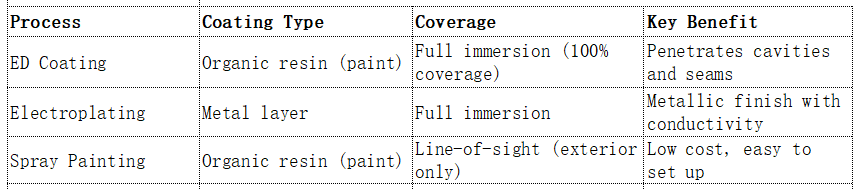
When to choose ED coating: If your parts have complex geometries with internal cavities, tight seams, or concealed areas — and you need reliable, long-term corrosion protection — ED coating is often the best solution.
- Knurling
Knurling is a mechanical process that creates a patterned texture on the surface of metal parts. It increases friction and improves grip without adding material.
Common applications:
· Conveyor rollers (improves traction)
· Screw heads and fasteners (enhances grip for manual adjustment)
· Hand-operated components (handles, knobs, thumb screws)
Key characteristics: Knurling is a forming operation that creates a raised or recessed diamond pattern. It does not affect corrosion resistance but significantly improves handling and functionality.
End of Guide — If you need additional details on any specific process or material compatibility, please contact us.