
Tolerance is one of the most important considerations in CNC machining. It determines how much a finished part is allowed to vary from its specified dimensions while still meeting design requirements.
Choosing the right tolerance is essential for achieving reliable assembly, maintaining product performance, and controlling manufacturing costs. Specifying tolerances that are tighter than necessary can significantly increase machining time, inspection requirements, and production expenses.
This guide explains what CNC machining tolerances are, standard tolerance ranges, factors that influence machining accuracy, and how engineers can select practical tolerances for different applications.
⸻
What Is CNC Machining Tolerance?
A machining tolerance is the permissible variation between the nominal dimension shown on an engineering drawing and the actual manufactured dimension.
For example, if a shaft diameter is specified as 20.00 mm ±0.02 mm, any finished part measuring between 19.98 mm and 20.02 mm is considered acceptable.
Tolerance ensures that manufactured parts can be assembled correctly without requiring additional fitting or modification.
⸻
Why Are Tolerances Important?
Every machined component must fit and function as intended. Proper tolerances help manufacturers produce consistent parts while ensuring compatibility with mating components.
Well-defined tolerances provide several important benefits:
- Reliable assembly
- Consistent product quality
- Improved interchangeability
- Better production efficiency
- Reduced scrap and rework
- Easier quality inspection
On the other hand, unnecessarily tight tolerances increase production costs without improving product performance.
⸻
Standard CNC Machining Tolerance Chart
The following values represent common tolerance ranges used in CNC machining.
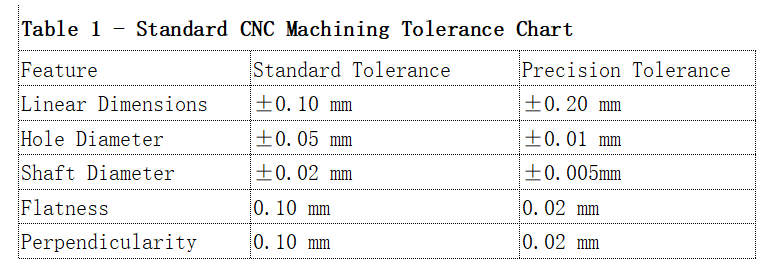
Actual achievable tolerances depend on material, machine capability, part geometry, and machining process.
⸻
Factors That Affect CNC Machining Tolerances
Machine Accuracy
Modern CNC machining centers are capable of producing highly accurate components, but regular calibration and preventive maintenance are essential for maintaining consistent precision.
⸻
Material Selection
Different materials respond differently during machining.
For example:
- Aluminum offers excellent machinability and dimensional stability.
- Stainless steel produces more cutting heat and increases tool wear.
- Titanium requires specialized tooling and machining parameters.
- Engineering plastics may expand or deform with temperature changes.
Material properties directly influence achievable tolerances.
⸻
Cutting Tools
Tool condition plays a critical role in machining accuracy.
Sharp cutting tools produce cleaner surfaces and more accurate dimensions, while worn tools may cause dimensional variation and poor surface finish.
Routine tool inspection and replacement help maintain consistent quality.
⸻
Workholding and Fixturing
A stable workholding system minimizes vibration and movement during machining.
Proper fixture design improves repeatability, especially for precision components with tight tolerances.
⸻
Machining Strategy
Machining sequence also affects final accuracy.
Using separate roughing and finishing operations allows stress to be relieved before final dimensions are achieved.
Reducing unnecessary setups helps minimize accumulated positioning errors.
⸻
How Tolerances Affect CNC Machining Cost
One of the most common misconceptions is that tighter tolerances always result in better products.
In reality, tighter tolerances require:
- More precise machine setup
- Additional machining operations
- Slower cutting speeds
- Higher-quality cutting tools
- Increased inspection time
- More experienced operators
The table below illustrates the relationship between tolerance and manufacturing cost.
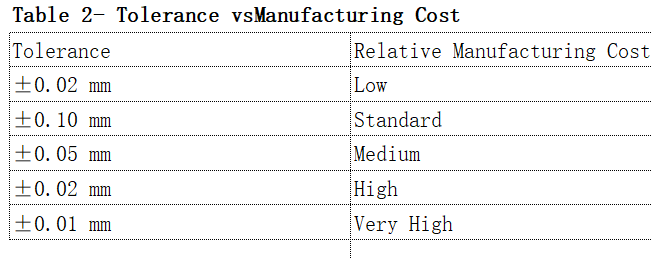
Whenever possible, engineers should specify tolerances based on functional requirements rather than selecting the smallest possible value.
⸻
ISO 2768 General Tolerances
Many engineering drawings use ISO 2768 as a general tolerance standard.
Instead of assigning individual tolerances to every dimension, ISO 2768 provides default tolerance classes for dimensions that are not specifically defined.
Using general tolerances simplifies drawings, reduces unnecessary inspection, and lowers manufacturing costs.
For many industrial components, ISO 2768 provides sufficient accuracy without requiring custom tolerance specifications.
⸻
How Are CNC Tolerances Measured?
Quality inspection is performed using precision measuring equipment such as:
- Digital Calipers
- Outside Micrometers
- Height Gauges
- Bore Gauges
- Thread Gauges
- Coordinate Measuring Machines (CMM)
- Surface Roughness Testers
Inspection methods are selected according to part complexity and customer requirements.
Inspection reports can also be provided upon request.
⸻
Common Tolerance Mistakes
Many engineering drawings include tolerance specifications that are unnecessarily strict.
Common mistakes include:
- Applying the same tolerance to every dimension
- Specifying precision that exceeds functional requirements
- Ignoring material behavior during machining
- Using non-standard hole and thread sizes
- Failing to discuss critical dimensions before production
Working closely with an experienced machining supplier during the design stage can help eliminate these issues.
⸻
Recommended Tolerances by Industry
Different industries require different levels of machining precision.
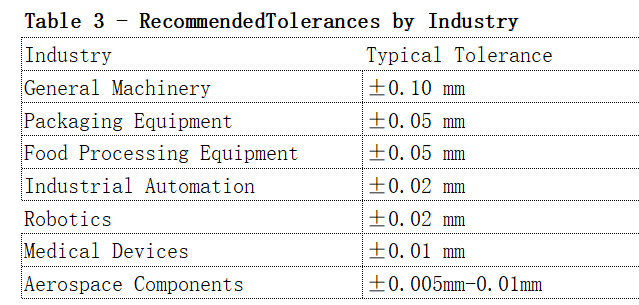
Selecting the correct tolerance depends on the product’s functional requirements rather than the industry alone.
⸻
How to Choose the Right Tolerance
When determining machining tolerances, engineers should consider:
- Product function
- Assembly requirements
- Material properties
- Manufacturing capability
- Inspection methods
- Production cost
- Lead time
The most economical tolerance is one that meets functional requirements without introducing unnecessary manufacturing complexity.
⸻
Conclusion
CNC machining tolerances directly influence product quality, manufacturing efficiency, and production cost.
Rather than applying extremely tight tolerances to every feature, engineers should select practical tolerance values based on the part’s intended function and assembly requirements.
Early collaboration with an experienced CNC machining supplier can improve manufacturability, reduce production costs, and ensure consistent product quality.
⸻
Frequently Asked Questions
What is the standard tolerance for CNC machining?
Most general CNC machined parts are produced with tolerances around ±0.10 mm, while precision components may require ±0.05 mm or tighter.
⸻
Can CNC machining achieve ±0.01 mm?
Yes. High-precision CNC machines, proper tooling, stable materials, and controlled machining conditions can achieve tolerances as tight as ±0.01 mm for suitable features.
⸻
Do tighter tolerances always improve quality?
No. Tight tolerances should only be specified where they are functionally necessary. Unnecessarily tight tolerances increase manufacturing costs and lead times.
⸻
Does material affect machining tolerance?
Yes. Aluminum is generally easier to machine accurately, while stainless steel, titanium, and engineering plastics require more careful process control.
⸻
Why do tighter tolerances cost more?
Tighter tolerances require more precise machining, additional inspection, slower cutting speeds, and higher-quality tooling, all of which increase manufacturing costs.